Plug Types You Will Actually Use in Australia
Two connectors decide how you live with a car here: Type 2 for AC charging and CCS2 for DC fast charging. If you are still comparing electric cars broadly, the practical filter is the plug, because a car that fits the chargers on your normal routes is easier to own than one that needs a detour every week. The published position is straightforward: XPENG vehicles are compatible with most public Type 2 AC and CCS2 DC chargers.

Key takeaways
- Type 2 handles AC charging; CCS2 handles DC fast charging, and the car accepts both.
- The charge flap sits on the right rear quarter panel: press the top-left corner, then connect.
- A 10-80% DC charge is published at 12 minutes on the New G6, with 5C battery technology.
- Home hardware adds plug-and-charge, a charging schedule and an anti-theft locking function.
Two connectors, two completely different jobs
Type 2 is the everyday plug. It carries alternating current from a wallbox or a public AC post into the car's onboard charger, and it is the connector you will use while you sleep or while you are at work. CCS2 is the road-trip plug: it adds two extra pins to the same basic shape and carries direct current straight to the battery, which is why a DC session is measured in minutes and an AC session in hours. Cars in Australia generally accept both, and the practical rule is that you only need to think about CCS2 when you are driving beyond the round trip you can cover comfortably at home.
Where the cable actually goes
The published detail is worth reading once, because it saves a small embarrassment at a public charger. The charge flap is on the right rear quarter panel: press the top-left of the flap and it opens, then connect the cable. Nothing about that is complicated, but it does mean you reverse into charging bays rather than nose in, which is the habit most owners settle into within a fortnight. Cable handling matters too: a coiled DC cable carries more weight than an AC lead, so the first few sessions are slower while you work out where to stand and how to loop the cable back onto the holster without dragging it across the paint.
Home hardware and the overnight habit
Home charging does the ordinary kilometres, and the published features are built around that: plug-and-charge so a session starts without a card or an app, Smart Guard anti-theft locking so the cable cannot simply be unplugged and taken, multi-account sharing for a household where more than one person drives, and a charging schedule so the car draws power inside the window your tariff treats kindly. For the New G6, whose published 10-80% charge time is 12 minutes on its 800-volt platform, the home routine is deliberately unexciting: park, plug, walk inside, and find the car full in the morning.
Public DC, and the chargers that surprise people
The public picture is better than most first-time buyers expect. XPENG vehicles are compatible with most public Type 2 AC and CCS2 DC chargers, and the site notes that some Tesla Supercharger sites in Australia are open to non-Tesla CCS2 vehicles, with compatibility to be checked in the Tesla app because not every site supports cars from other brands. If you ever see XPENG network numbers such as 772 branded supercharging stations, 1,870 free charging stations and 319 cities, note that those describe the network in China rather than anything in Australia. The manufacturer's own high-power unit is described as a 480 kW charger with a 670A+ flow rate, liquid cooling, IP67 protection and a built-in safety monitoring chip, which tells you the direction the hardware is heading rather than what is on your street today.
| Connector | Current | Where you meet it | Typical session |
|---|---|---|---|
| Type 2 | AC | Home wallbox, workplace, public AC posts | Overnight or across a working day |
| CCS2 | DC fast | Highway and suburban rapid chargers | Published 10-80% in 12 minutes |
| Both | AC and DC | The same car, one flap on the right rear quarter panel | Whichever suits the trip |
Charging away from home: what to keep in the car
The kit you carry decides how relaxed a public charge feels. An AC lead lives in the boot permanently, even if you rarely use it, because it turns any accessible power point into a slow but useful top-up and it costs nothing to store. A DC cable is provided by the charger rather than the car, so there is nothing to pack for a rapid stop. Beyond that, a pair of gloves is the underrated accessory on a cold morning, when metal connectors and wet cables are unpleasant at six in the morning, and a cloth for the flap and the connector pins keeps dust and grit out of the interface. Route your first few public charges through places you already stop rather than making a special trip, and the habit forms faster. If you are towing, or carrying a bike rack that blocks the rear, note that the charge flap is on the right rear quarter panel and check access before you commit to a bracket that lives permanently on the towbar.
Worked example: the cover behind the plug
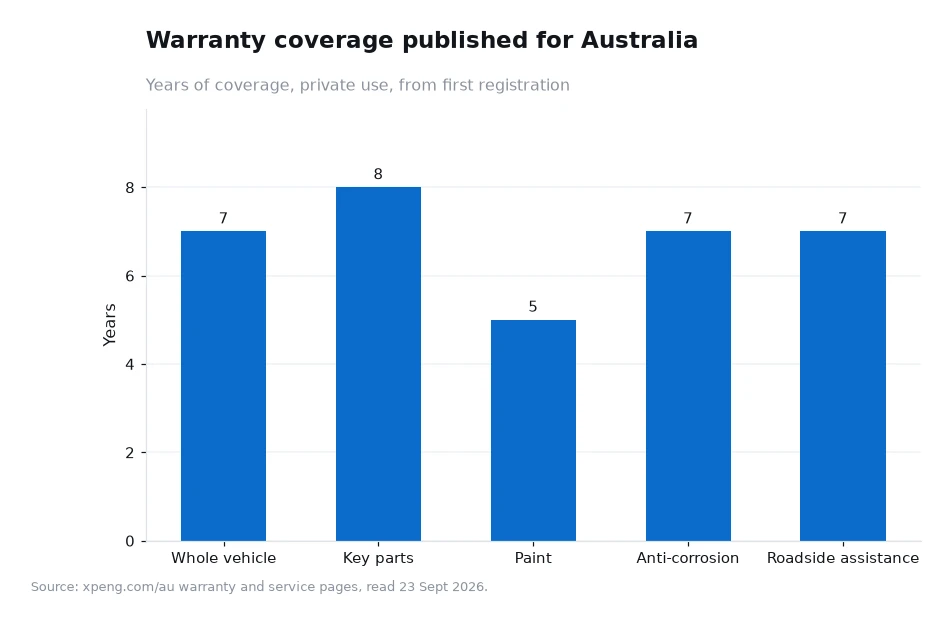
This is an illustrative calculation with assumptions stated, not manufacturer data, and it matches the chart further down this page. Assume 15,000 km a year. Whole-vehicle cover is 7 years unlimited kilometres for private use, so 7 x 15,000 = 105,000 km of driving sits inside it, with the calendar, not the odometer, ending that term. Key parts cover is 8 years or 160,000 km, whichever comes first: 8 x 15,000 = 120,000 km, which never reaches the 160,000 km cap, so the calendar ends that one too. Reaching 160,000 km in 8 years would take 160,000 / 8 = 20,000 km a year. Scheduled servicing runs every 12 months or 20,000 km, whichever comes first, so at this distance the annual visit is the one that fires and you book 7 services across 7 years. Drive 25,000 km a year and the arithmetic flips: the 20,000 km interval arrives first each time, which is 160,000 / 20,000 = 8 services across the 8-year key parts window.
Frequently asked questions
What is the difference between Type 2 and CCS2?
Type 2 carries alternating current and is the connector used for home and workplace charging, where a session runs for hours. CCS2 carries direct current for fast charging and is the connector you look for on a long drive, where the published 10-80% window is 12 minutes on the New G6.
Can you charge an XPENG at a Tesla Supercharger in Australia?
Some Tesla Supercharger sites in Australia are open to non-Tesla CCS2 vehicles, and the manufacturer advises checking the Tesla app for site compatibility, because not every site supports cars from other brands. Treat availability as site by site rather than as a national yes.
A short checklist before your first charge
Confirm which cable came with the car, then check the Australian model line-up to see which configurations and charging features are published for the variant you are pricing. Then buy only the home hardware that suits your parking arrangement rather than the most powerful option on the shelf. Learn where the flap release sits on the right rear quarter panel, practise looping the cable once, and set a charging schedule inside your off-peak window. After that the plug question mostly disappears, which is the point: the good outcome is not thinking about connectors at all. The detailed charging notes, including the app-based home features, are on the manufacturer's charging page.
Charging compatibility, connector types and warranty terms in this article are as published on the manufacturer's Australian site and read on 23 Sept 2026. The home arithmetic in the worked example is my own and uses stated assumptions; WLTP range and charge times depend on conditions. Verify the terms that apply to your configuration with a dealer. [1]