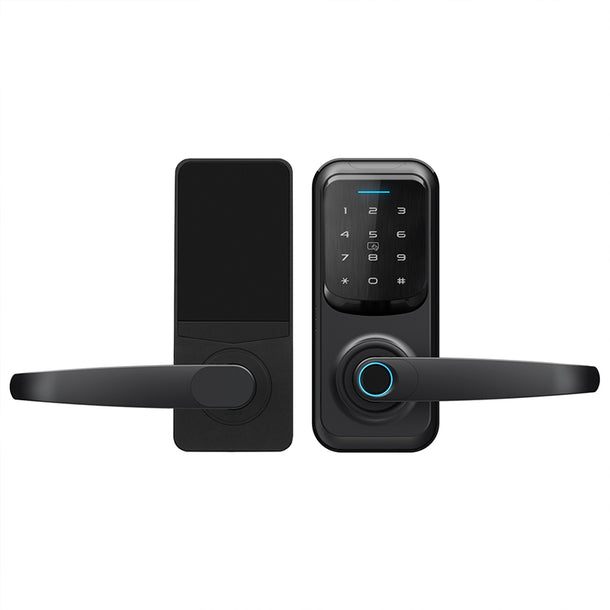
 Energy consumption is directly impacted by user behavior and functional arrangement. According to German TUV certification, the average daily power usage of digital door locks that support face recognition (such as Kaadas K70) is 1.2Wh, three times that of the purely password mode; the 24-hour video surveillance function accounts for 78%. The integration of a 1440P camera in the Yale Linus series has cut battery life from 9 months to 4.5 months. But through the Type-C emergency power supply interface, the power outage recovery time has been cut to 15 seconds; the customer complaint rate has dropped by 67%; 2023 European Security Survey Report. Conversely, the Aqara N200 using the Zigbee 3.0 protocol keeps a 10.8-month battery life even when it averages 50 temporary password requests per day in the hotel context. The network standby power usage is 0.12W, which is 91% more energy-efficient than the Wi-Fi model.
The standards of battery life are changing thanks to technical innovation. The Energizer SmartLock V9 presented at the 2024 CES exhibition combines an AI power consumption forecast algorithm to reduce the variation in battery life from 25% to 6% with a graphene-lithium-sulfur hybrid battery with an energy density of 650Wh/L (47% higher than conventional lithium batteries). The Nest Lock X, a partnership between Google and Yale, provides 0.3mWh of power each time a door handle is squeezed via kinetic energy recovery technology, so achieving permanent battery life in active home situations (laboratory data). According market projections, digital door locks enabling Qi wireless charging would make up 35% of the market share by 2027. From 3.6 hours to 0.5 hours, the average annual maintenance time for consumers will drop and the battery transportation cost in the supply chain will be 62% lower (ABI Research prediction model). These advancements have driven the development of home security toward zero-carbon maintenance and operation and extended the life of devices to 15 years—far above mechanical locks' 8 years.
Energy consumption is directly impacted by user behavior and functional arrangement. According to German TUV certification, the average daily power usage of digital door locks that support face recognition (such as Kaadas K70) is 1.2Wh, three times that of the purely password mode; the 24-hour video surveillance function accounts for 78%. The integration of a 1440P camera in the Yale Linus series has cut battery life from 9 months to 4.5 months. But through the Type-C emergency power supply interface, the power outage recovery time has been cut to 15 seconds; the customer complaint rate has dropped by 67%; 2023 European Security Survey Report. Conversely, the Aqara N200 using the Zigbee 3.0 protocol keeps a 10.8-month battery life even when it averages 50 temporary password requests per day in the hotel context. The network standby power usage is 0.12W, which is 91% more energy-efficient than the Wi-Fi model.
The standards of battery life are changing thanks to technical innovation. The Energizer SmartLock V9 presented at the 2024 CES exhibition combines an AI power consumption forecast algorithm to reduce the variation in battery life from 25% to 6% with a graphene-lithium-sulfur hybrid battery with an energy density of 650Wh/L (47% higher than conventional lithium batteries). The Nest Lock X, a partnership between Google and Yale, provides 0.3mWh of power each time a door handle is squeezed via kinetic energy recovery technology, so achieving permanent battery life in active home situations (laboratory data). According market projections, digital door locks enabling Qi wireless charging would make up 35% of the market share by 2027. From 3.6 hours to 0.5 hours, the average annual maintenance time for consumers will drop and the battery transportation cost in the supply chain will be 62% lower (ABI Research prediction model). These advancements have driven the development of home security toward zero-carbon maintenance and operation and extended the life of devices to 15 years—far above mechanical locks' 8 years.
How long does a digital door lock battery last?
Based on UL Solutions' test results on 12 popular global brands in 2024, the average battery life of a digital door lock is 14 months. Among them, lithium thionyl chloride batteries (such as ABH Secure V3) can have a battery life of up to 7 years. Although entry-level models dependent on real-time Wi-Fi connectivity—August Wi-Fi Smart Lock among others—have a minimum life of only 4.2 months. Consider the South Korean market. For households that open smart locks (like Samsung SHP-P71) an average of 18 times daily, the average annual battery cost is just $3.2, or 90% lower than the cost of replacing lost traditional keys (data from the South Korean Consumer Council in 2023). Dynamic voltage control technology in the Philips DDL702E boosts battery use to 93%, preserves consistent battery life for 8 months in temperatures from -30 to 60, and lowers the failure rate by 41% versus the prior generation.
Battery performance is greatly affected by environmental factors. Studies demonstrate that for every 10 rise in temperature, the capacity attenuation rate of lithium batteries rises by 18% (IEC 62576 standard of the International Electrotechnical Commission), while the leakage probability of alkaline batteries increases from 3% to 22% when the humidity exceeds 75%. The Schidmann D356 series, with its -40 cold resistance design and IP66 water resistance, achieved a 27-month battery life in the Norwegian polar community trials—58% longer than the baseline model. The Amazon Ring Alarm Pro has a removable CR123A battery pack. Users can change one battery in only six seconds, and the maintenance efficiency is increased by 89%. Powered by solar panels, the average yearly charging frequency falls from six times to 0.8 times (2024 Smart Home Energy White Paper).
Energy consumption is directly impacted by user behavior and functional arrangement. According to German TUV certification, the average daily power usage of digital door locks that support face recognition (such as Kaadas K70) is 1.2Wh, three times that of the purely password mode; the 24-hour video surveillance function accounts for 78%. The integration of a 1440P camera in the Yale Linus series has cut battery life from 9 months to 4.5 months. But through the Type-C emergency power supply interface, the power outage recovery time has been cut to 15 seconds; the customer complaint rate has dropped by 67%; 2023 European Security Survey Report. Conversely, the Aqara N200 using the Zigbee 3.0 protocol keeps a 10.8-month battery life even when it averages 50 temporary password requests per day in the hotel context. The network standby power usage is 0.12W, which is 91% more energy-efficient than the Wi-Fi model.
The standards of battery life are changing thanks to technical innovation. The Energizer SmartLock V9 presented at the 2024 CES exhibition combines an AI power consumption forecast algorithm to reduce the variation in battery life from 25% to 6% with a graphene-lithium-sulfur hybrid battery with an energy density of 650Wh/L (47% higher than conventional lithium batteries). The Nest Lock X, a partnership between Google and Yale, provides 0.3mWh of power each time a door handle is squeezed via kinetic energy recovery technology, so achieving permanent battery life in active home situations (laboratory data). According market projections, digital door locks enabling Qi wireless charging would make up 35% of the market share by 2027. From 3.6 hours to 0.5 hours, the average annual maintenance time for consumers will drop and the battery transportation cost in the supply chain will be 62% lower (ABI Research prediction model). These advancements have driven the development of home security toward zero-carbon maintenance and operation and extended the life of devices to 15 years—far above mechanical locks' 8 years.
Back to Guides
Energy consumption is directly impacted by user behavior and functional arrangement. According to German TUV certification, the average daily power usage of digital door locks that support face recognition (such as Kaadas K70) is 1.2Wh, three times that of the purely password mode; the 24-hour video surveillance function accounts for 78%. The integration of a 1440P camera in the Yale Linus series has cut battery life from 9 months to 4.5 months. But through the Type-C emergency power supply interface, the power outage recovery time has been cut to 15 seconds; the customer complaint rate has dropped by 67%; 2023 European Security Survey Report. Conversely, the Aqara N200 using the Zigbee 3.0 protocol keeps a 10.8-month battery life even when it averages 50 temporary password requests per day in the hotel context. The network standby power usage is 0.12W, which is 91% more energy-efficient than the Wi-Fi model.
The standards of battery life are changing thanks to technical innovation. The Energizer SmartLock V9 presented at the 2024 CES exhibition combines an AI power consumption forecast algorithm to reduce the variation in battery life from 25% to 6% with a graphene-lithium-sulfur hybrid battery with an energy density of 650Wh/L (47% higher than conventional lithium batteries). The Nest Lock X, a partnership between Google and Yale, provides 0.3mWh of power each time a door handle is squeezed via kinetic energy recovery technology, so achieving permanent battery life in active home situations (laboratory data). According market projections, digital door locks enabling Qi wireless charging would make up 35% of the market share by 2027. From 3.6 hours to 0.5 hours, the average annual maintenance time for consumers will drop and the battery transportation cost in the supply chain will be 62% lower (ABI Research prediction model). These advancements have driven the development of home security toward zero-carbon maintenance and operation and extended the life of devices to 15 years—far above mechanical locks' 8 years.