First Impressions: Judging a Character in the First Five Messages
You do not need half an hour to know whether a character is worth the rest of the session. Five messages will do it, because each of the first five tests something different: whether the card picks up your opener, holds its register, adds detail, sets a workable pace, and remembers anything it was told.

Key takeaways
- Give each of the first five messages one job: pickup, register, detail, pace and recall.
- Five messages at roughly 30 seconds each is about 2.5 minutes, so 16 tests a month costs well under an hour.
- A candidate that fails two of the five rarely recovers later, and one that fails recall is unlikely to suit a long storyline.
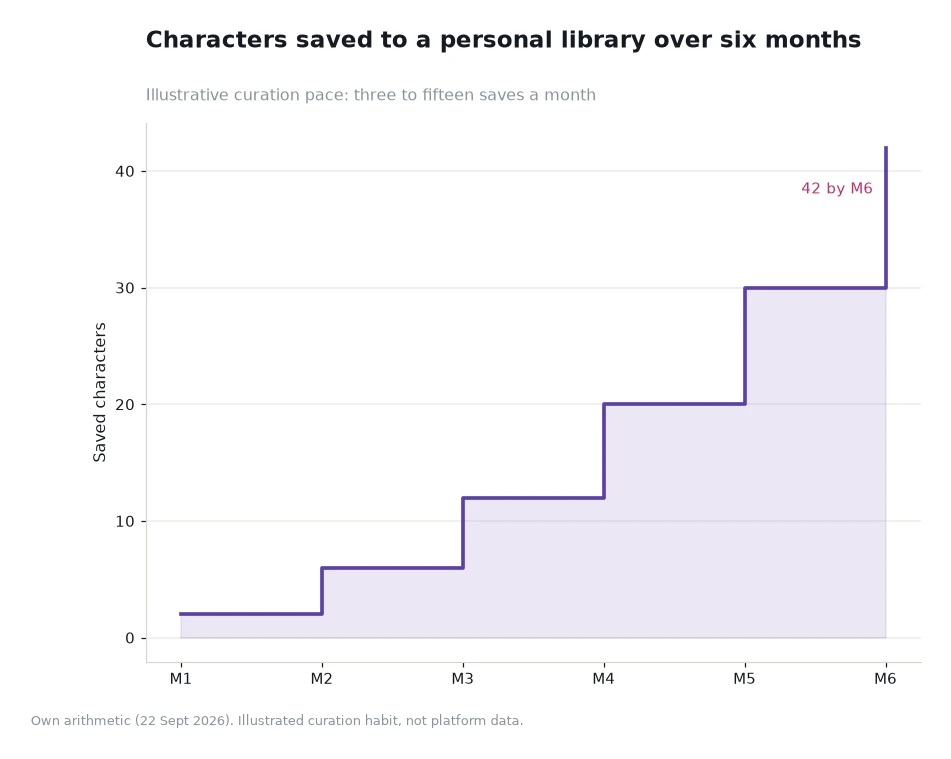
- Saves are the outcome that matters: a library reaching 42 entries across six months is built from tests like these, not from impressions.
Why five messages is the right length
The first message of a session is the card's opening hand, and it tells you more about register than any card description. The next four are your tests, and they are enough to separate a card that is actively following the exchange from one that is producing generic text at the right temperature.
Five is also about the limit of what you can judge fairly. Past that point you are no longer assessing a character, you are assessing a conversation, and conversations improve for reasons that have nothing to do with the card — your own familiarity with it, for instance. That is also why the test works best on a card you have not read about elsewhere: expectation is a kind of familiarity, and it makes a first impression harder to read honestly.
The method costs little. Five messages at about 30 seconds each is roughly 2.5 minutes, so sixteen tests in a month is around 40 minutes in total, spread across sessions you were going to have anyway.
What each of the five messages tests
The first message tests pickup. Write something specific — a place, a time of day, a small detail — and see whether the reply uses it or answers around it. The second tests register: whether the card's tone is stable now that the conversation has moved on from its prepared opening.
The third tests detail. A card that invents something consistent with what you wrote is doing more work than a card that asks another question. The fourth tests pace, and the honest comparison is with your own writing: if the card answers in three sentences and you write in one, the mismatch will wear within a week.
The fifth tests recall, which is the cheapest of the five to check and the most predictive of a long storyline. Mention a detail in message one and see whether it reappears in message five without prompting. The platform's own claim is that characters recall previous interactions and adapt over time, so this is a claim you can verify in a couple of minutes.
| Message | What it tests | Pass | Fail |
|---|---|---|---|
| One | Pickup of your opener | The reply uses the specific detail you wrote | A generic response that ignores it |
| Two | Register | Tone holds once the prepared opening is done | Tone drifts or flattens immediately |
| Three | Added detail | Invents something consistent with your setup | Asks another question instead of contributing |
| Four | Pace | Reply length suits the length of your turns | Paragraphed replies against one-line answers |
| Five | Recall | An early detail returns unprompted | No memory of anything from four messages ago |
Worked example: what a five-message habit produces
Run the test on four candidates a week and you have tested sixteen cards in a month for roughly 40 minutes of effort — about 8% of an eight-hour month built from half-hour sessions. Nothing else in a text-chat routine has that ratio of information to time.
The output is a shortlist rather than a verdict. Take the cards that passed all five and keep them; park the ones that passed three or four; close the ones that failed two or more and do not reopen them this month. If a library grows under an illustrative pace of 2, then 6, 12, 20, 30 and 42 saves across six months, the tests are what produced those entries, because none of the 42 was kept on a first impression alone.
There is a second-order benefit that shows up in the numbers. Sixteen tests a month and two or three saves is a healthy ratio: it means the tests are doing their job of rejecting cards, rather than the library absorbing everything that looked interesting at a glance.
Where to find candidates worth testing
Testing is only as good as the queue it draws from. The platform's ai nsfw board is a practical source because it puts a tag row and a creator credit on every card, so you can pick candidates that plausibly match your register before spending even 2.5 minutes on a test.
Crushon publishes a fresh ordering each Thursday, which is a convenient rhythm for building a queue of four candidates a week. Reading a list of NSFW AI characters this way turns a browse into a shortlist: four names in, one or two tested properly, the rest left for the following week.
The test also teaches you what to look for on the card itself. After a fortnight of five-message checks you will know which tags correlate with your own pass rate, and that knowledge shortens the queue-building step from ten minutes to two. The tags do not need to be accurate in the abstract; they only need to predict well for you.
If the queue runs dry, the character search page filters the wider catalogue by keyword, and the AI chat blog has background on how prompting and pacing affect what a card can do with an exchange.
Frequently asked questions
Can five messages really tell me whether to keep a character?
It tells you whether to spend more time, which is the decision that matters. Recall and register are visible that early, and a card that fails both rarely improves with a longer session.
How long does the test take?
About 2.5 minutes at roughly 30 seconds a message. Sixteen tests a month therefore costs around 40 minutes, or about 8% of an eight-hour month.
What should I do with a card that passes three tests out of five?
Park it rather than keeping it. A partial pass is a reasonable reason to return in a fortnight, and a poor reason to add it to the library straight away.
Test first, save second
Keep the five-message habit small enough to run on every candidate and strict enough to reject most of them. Save only what passed, park what nearly passed, and let the queue refill on Thursday rather than opening a fresh chat every time a card catches your eye. Two or three saves a month is a healthy rate; a library growing faster than that usually means the test was skipped rather than that the month was unusually good. Return to the parked cards before adding new ones, because a card that cleared three tests out of five has already earned the second look.
Data and sources: the recall claim, tag rows and weekly refresh published on CrushOn.AI[1], read 22 Sept 2026. The 30-second message, the 40-minute monthly total and the six-month save curve are illustrative assumptions, not platform data. This article is aimed at adults aged 18 and over.