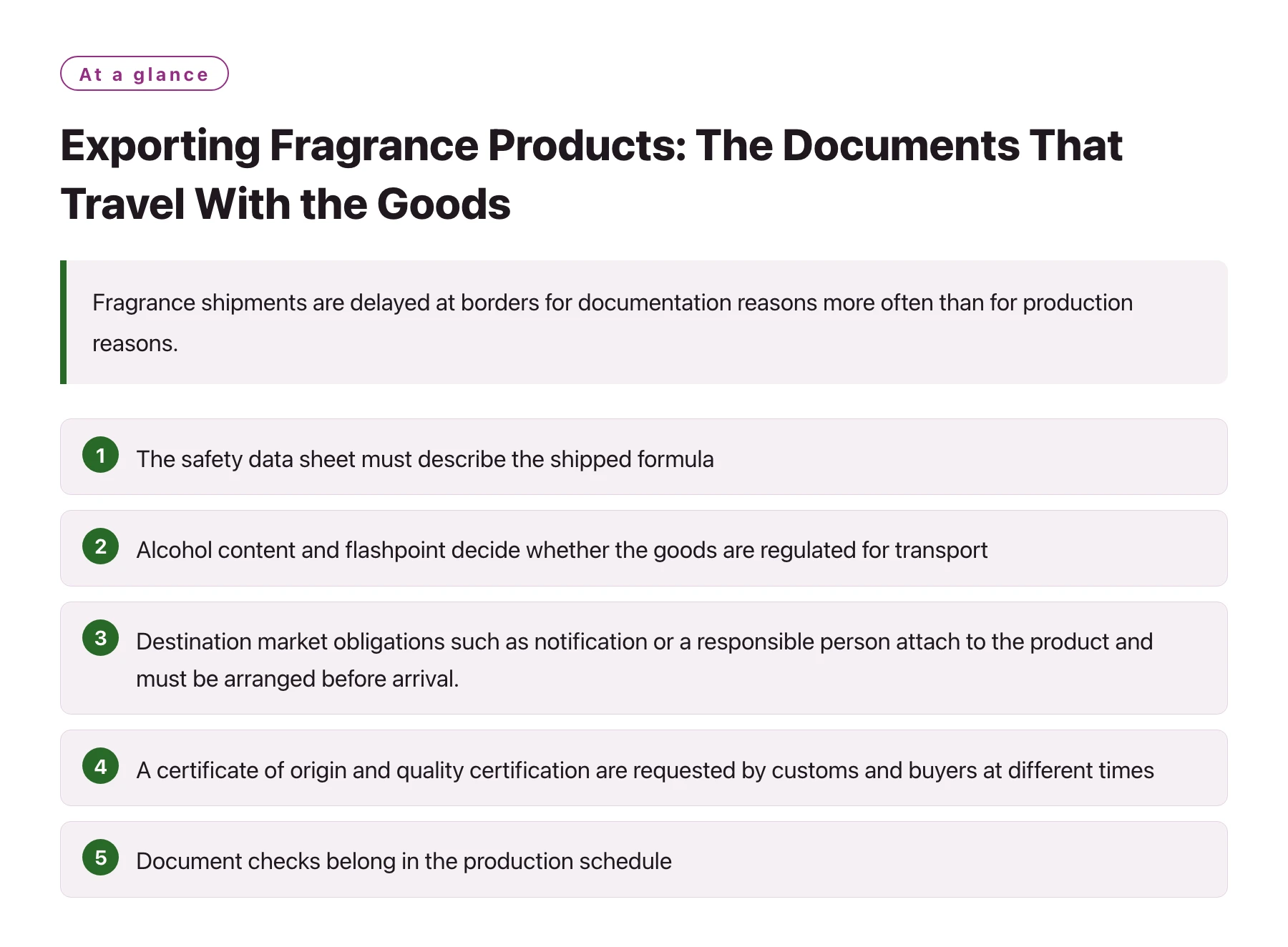
Fragrance shipments are delayed at borders for documentation reasons more often than for production reasons. The document set is predictable and finite: a safety data sheet that matches the formula, correct transport classification for the alcohol content, proof of origin and quality certification, and the destination market's notification or responsible-person arrangements. All of it can be prepared before the goods are packed, and almost none of it can be fixed quickly afterwards.
Key takeaways
- The safety data sheet must describe the shipped formula, so it has to be regenerated whenever the formula or its materials change.
- Alcohol content and flashpoint decide whether the goods are regulated for transport, which affects packaging, labelling and cost.
- Destination market obligations such as notification or a responsible person attach to the product and must be arranged before arrival.
- A certificate of origin and quality certification are requested by customs and buyers at different times, so keep both current.
- Document checks belong in the production schedule, because a missing authorisation cannot be produced at the port.
Brands tend to treat export documentation as the last mile of a project: pack the goods, then ask the freight forwarder what is needed. By then, the label artwork is printed and the shipment date is fixed, so every missing item becomes an expedited cost.
The alternative is to treat documentation as a design constraint. Decide the destination markets before the artwork is final, list the documents each market requires, and build their production into the timeline. That is less work than it sounds, because the list is short and largely the same across fragrance products.
This article sets out the document set, who normally issues each item, and the specific points where fragrance shipments most often stall.
The document set, and where each one comes from
| Document | Normally issued by | Must exist by | What stalls without it |
|---|---|---|---|
| Safety data sheet | The manufacturer, for the exact formula shipped | Before booking transport | Carrier refusal or a customs query on the classification |
| Transport classification and declaration | The shipper, based on the safety data sheet | Before booking transport | Re-packing or re-labelling at the warehouse |
| Commercial invoice and packing list | The seller | At shipment | Customs valuation queries and delayed release |
| Certificate of origin | A chamber of commerce or the relevant authority | Before arrival, if the buyer requires it | Loss of a preferential duty treatment the buyer expected |
| Quality and GMP certification | The certifying body, in the manufacturer's name | With the shipment documents | Buyer or retailer refusal to accept the goods |
| Ingredient and allergen declaration | The manufacturer, aligned with the approved artwork | Before the label is printed | Re-labelling, and possible market notification issues |
| Destination market notification | The brand or its appointed representative | Before the product is placed on sale | Goods held in the destination market |
Notice how many of these must exist before transport is booked rather than before arrival. That is the practical argument for preparing the set at the sampling stage: the safety data sheet and the ingredient declaration both follow the approved formula, so they can be drafted as soon as it is frozen.
Transport classification, and why it changes everything downstream
Fragrance products with an alcohol base are flammable liquids, and alcohol content together with flashpoint determines whether and how the goods are regulated for transport. That determination is not a formality: it decides the packaging instruction, the labelling on the outer carton, the quantity allowed per package and the freight rate.
Because the classification depends on the formula, it cannot be settled before the formula is settled. It also changes if the formula changes, which is one more reason to freeze the formula before booking freight rather than after.
The safety data sheet has to match what is in the box
A safety data sheet copied from a similar product is worse than none, because it creates a mismatch that a carrier or inspector can detect. The document has to describe the composition, the physical properties and the hazards of the shipped goods, in the format required by the destination jurisdiction.
Ask the manufacturer to confirm in writing that the sheet supplied corresponds to the production batch formula, and to reissue it whenever a material is substituted.
Ask the carrier early
Freight forwarders and carriers apply their own acceptance rules on top of the regulations, and some routes restrict alcohol-based fragrance more tightly than the rules require. A short conversation before the packing date is cheaper than discovering the restriction when the pallet is ready.
Get the acceptance position in writing, including any quantity limit per package, and pass it to whoever packs the goods.
The most common single failure is an ingredient or allergen declaration that no longer matches the artwork, usually after a late formula adjustment. The label was approved, the formula was tweaked for stability or cost, and the declaration was not revisited. Recovering from that means reprinting labels, reworking cartons and, in some markets, amending a notification. Build a final check into the schedule: compare the approved formula, the artwork and the declaration document side by side, and have somebody who is not on the development team sign that comparison off.
Destination market obligations belong on the same list
Transport documents get the goods to the border; market rules decide whether they can be sold. In the European Union, cosmetic products must have a responsible person established in the market and a product information file available for inspection, and those obligations sit with an entity rather than with the factory [1].
Other markets have their own mechanisms. Canada, for example, requires cosmetic products to be notified and maintains an ingredient hotlist that restricts or prohibits certain substances, with the details published by the regulator [2]. None of these processes is complicated, but each has a lead time and each needs the final formula and label.
Decide who is the responsible entity before printing
For each market, write down which company acts as the responsible entity, who holds the product information file, and who responds to a regulator. If that entity is not the manufacturer, the arrangement needs to be in place before the goods leave, because the file has to be complete at the point of placing on the market.
This is also where the label wording decisions land. Claims, ingredient names and warnings are part of the same compliance picture, so the label and the file should be reviewed together rather than in sequence.
Keep the document pack with the shipment record
Store the final version of every document alongside the shipment record, in the form it was actually sent. When a buyer, carrier or authority asks a question months later, the version that matters is the one that travelled with the goods, not the draft that was superseded.
A supplier's published certification list, such as the one shown on the official Xuelei website, is a useful starting point for understanding which documents a manufacturer can typically provide, but the accepted list for your shipment should always be confirmed in writing for that order.
Preparing the pack, in order
- Freeze the formula and the label togetherSettle the composition and the artwork at the same time, because both the safety data sheet and the declarations depend on them.
- Request the safety data sheet for the shipped formulaAsk the manufacturer to confirm in writing that it describes the production formula, not a similar product.
- Confirm the transport classification with the carrierGet acceptance rules, packaging limits and any route restrictions in writing before the packing date.
- Check destination market obligationsIdentify the responsible entity, the notification requirement and any ingredient restrictions for each market you sell in.
- Assemble origin, quality and commercial documentsCertificates, invoice, packing list and origin paperwork, each checked for consistency with the shipment.
- Run a final cross-check before the goods moveCompare approved formula, printed label and declaration documents, signed off by somebody outside the development team.
- Archive the exact set that travelledKeep the sent versions with the shipment record so later queries can be answered from evidence.
Sources
- European Commission: Cosmetics in the EU —— The European Commission's overview of EU cosmetics rules, including the responsible person, product information file and safety report requirements.
- Health Canada: Cosmetic Safety —— Health Canada's cosmetics pages, covering cosmetic notification, the ingredient hotlist and safety requirements for cosmetics sold in Canada.
Frequently asked questions
Is perfume considered dangerous goods for shipping?
Alcohol-based fragrance products are flammable liquids, and whether they are regulated for transport depends on the alcohol content and flashpoint of the specific formula. That determination governs packaging, labelling and quantity limits, so it should be confirmed with the carrier using the safety data sheet for the shipped goods.
Who prepares the safety data sheet?
The manufacturer normally provides it, because it depends on the composition and physical properties of the formula. The shipper then uses it to establish the transport classification. Ask for written confirmation that the document describes the exact formula being shipped.
What does an EU responsible person do?
That entity ensures the product meets European cosmetic requirements, holds the product information file and is the contact point for authorities. It must be established in the market, and the arrangement should be in place before the product is placed on sale there.
Do I need a certificate of origin for every shipment?
Not always, but it is commonly requested by buyers and customs, and it may affect duty treatment under a trade arrangement. Establish whether your buyer needs it and whether the origin rules are met before booking transport, since it cannot be issued retroactively in every case.
What causes most delays in fragrance exports?
Document mismatches: a safety data sheet that describes a different formula, an ingredient declaration that no longer matches the label after a late change, or a missing market notification. All are avoidable by checking the documents against the final formula before the goods are packed.