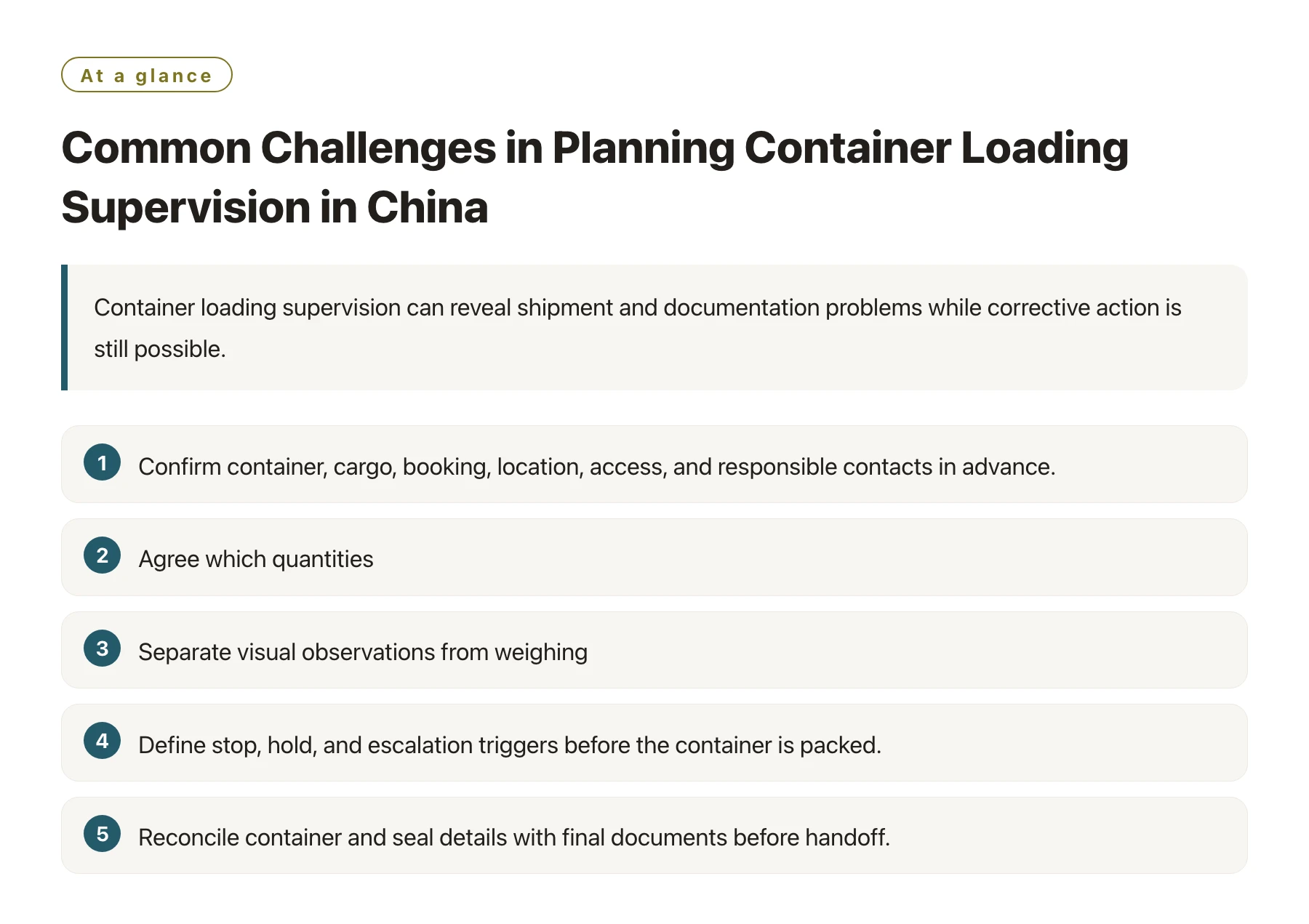
Container loading supervision can reveal shipment and documentation problems while corrective action is still possible. The work needs a defined scope, ready cargo, approved documents, safe access, a trained observer, and a route for pausing or escalating a concern. Plan what will be checked, who will decide, and what evidence will be captured before the loading date. A visit without clear authority can document a discrepancy but may not prevent it from becoming a sealed shipment.
Key takeaways
- Confirm container, cargo, booking, location, access, and responsible contacts in advance.
- Agree which quantities, marks, condition, packing, and loading stages will be observed.
- Separate visual observations from weighing, engineering, customs, and carrier decisions.
- Define stop, hold, and escalation triggers before the container is packed.
- Reconcile container and seal details with final documents before handoff.
A loading plan should make the scope and limits of the observer’s role clear to the factory and buyer.
1. Define the shipment and observation scope
Record purchase order, supplier, factory address, booking reference, cargo description, product codes, planned quantities, packing list revision, container type, loading date, and destination. State whether the task covers container condition, carton marks, counts, stowage observation, packaging, seal application, or document reconciliation. Specify what is outside scope, such as laboratory testing, customs clearance, formal container weighing, or engineering certification.
Agree who appoints the supervisor, who gives instructions on site, who can authorize a hold, and how the buyer will receive urgent updates. Identify primary and backup contacts for procurement, quality, supplier operations, and freight. If the observer cannot stop unsafe work or prevent sealing, state the limitation and identify the person who can make that decision.
2. Confirm readiness before dispatching a supervisor
Ask the supplier to confirm finished quantity, packing status, access to the loading area, staff availability, equipment, weather protection, and document readiness. Request current photos or a staged loading plan when useful, but do not treat them as a substitute for agreed on-site observations. Set a latest confirmation time and a process for postponement if cargo or documents are not ready.
Give the supervisor the approved product schedule, carton marks, packing list, loading instruction, and known risk points. Confirm the local working hours, site safety rules, personal protective equipment, photography permission, language support, and emergency contact. A visit should not begin with conflicting revisions or an assumption that the observer may enter restricted areas without authorization.
3. Check the container and goods before loading
Record the container number and photograph accessible exterior and interior condition before cargo enters. Check visible cleanliness, dryness, odor, holes, damage, door operation, floor condition, and locking hardware. State any area not inspected. Verify product identity and package marks against the approved order using the agreed sampling or full-count method. Keep cartons with unclear identity, damage, or substitution visible as separate findings.
Agree how shortages, overages, mixed cartons, and packaging damage will be escalated. The supplier may correct an error, replace packages, amend a packing list, or request a deviation, but each disposition needs approval from the responsible party. Capture evidence before rework changes the original condition. Use package, pallet, and piece units consistently so count differences do not disappear in arithmetic.
4. Observe loading and securing within role
Record the loading sequence, start and finish times, package counts, and key stages with clearly identified photos. Compare visible cargo arrangement with the approved plan, noting unstable stacks, apparent voids, damaged pallets, or packages that may shift. The IMO/ILO/UNECE CTU Code provides guidance on packing and securing cargo transport units; technical loading and securing decisions should be made by qualified, authorized personnel. A supervisor should document concerns and seek review rather than improvise a stowage design. [1]
Confirm who controls forklifts, lifting, blocking, bracing, and access to the container. Do not ask an inspector to perform hazardous physical work or enter a unit without site authorization and safe procedures. If a concern suggests immediate danger, use the site emergency and stop-work process, notify the designated contact, and record the action taken.
5. Clarify mass and shipping-document responsibility
Check whether the required verified gross mass record has been prepared, which container it covers, and whether the shipping document references the same shipment. Do not estimate or alter a weight from carton counts. IMO describes SOLAS requirements under which the shipper provides the verified gross mass sufficiently in advance for vessel stowage planning, and VGM is a condition for loading a packed container onto a ship. [2]
The loading observer may record document presence and visible mismatches but should not replace the responsible shipper, approved weighing party, carrier, terminal, or competent authority. If a weight record is missing or inconsistent, escalate it before the container leaves the loading point. Identify who will submit corrected information and confirm the carrier receives it by the required time.
6. Set clear pause and release triggers
List conditions that require a hold: wrong container identity, unresolved quantity variance, missing required weight evidence, unapproved substitution, material damage, unsafe loading condition, incorrect seal, or incomplete shipment documents. Define whether the hold applies to one product group, the entire container, or only final release. Give the supplier a response contact and time limit that reflects the booking schedule without weakening the acceptance rule.
Distinguish a request for clarification from a formal disposition. A buyer may authorize a documented deviation, require replacement, request rework, or reject a lot. Record who made the decision and what evidence supported it. Do not treat silence, a vessel booking, or an inspector’s signature as automatic approval unless the agreed contract explicitly gives it that meaning.
7. Close the container and preserve traceability
After final reconciliation, record container number, product and package totals, seal type and number, person applying the seal, date and local time, and open exceptions. Photograph the seal legibly and compare it with the shipping instruction or other agreed record. If a seal is replaced, retain both old and new numbers and the reason. Store photos with shipment and order identifiers so another reviewer can retrieve the evidence.
Compare the final packing list, load tally, shipment instructions, weight document, container number, and seal number. Send the report to the buyer and logistics contact before release where timing allows. If a record remains conditional, mark it clearly and identify the owner and next action. Keep copies of superseded documents so the history of a correction is not lost.
8. Review performance after arrival
After delivery, compare loading observations with receiving results, damage claims, shortages, seal reports, and shipping delays. Investigate whether the issue arose from factory packing, loading, transport, or unloading; do not assign cause without evidence. Use the findings to adjust future checklists, photograph points, site instructions, and escalation timing.
A repeatable plan helps buyers compare suppliers without assuming all factories and products present the same risks. Buyers arranging JS Sourcing cargo loading supervision can agree the observation scope, contacts, and reporting format before the container is booked, then retain shipment-specific evidence for each order.
Sources
Frequently asked questions
What should be agreed before container loading supervision?
Confirm scope, shipment identity, documents, schedule, site access, safety rules, observer authority, evidence needs, stop triggers, escalation contacts, and the person who can release the load.
Can a loading supervisor certify that a container is safe to sail?
Not solely by observation. The supervisor records agreed checks and escalates concerns; carrier, shipper, terminal, and qualified technical parties retain their assigned responsibilities.
Who is responsible for verified gross mass information?
The applicable SOLAS process places responsibility on the shipper to provide verified gross mass information. Confirm roles, method, document, and submission timing with the responsible shipping parties.
What evidence should a loading report preserve?
Keep container identity, condition photos, product and carton tallies, loading-stage evidence, open findings, document references, seal number, timestamps, contacts, and final dispositions.